Brave Steps Daily
Building real confidence, one small habit at a time
The myth that breaks most kids
Most people believe confidence works like this: “Once I feel confident, I will do brave things.”
It actually works the opposite way: You do small brave things first, and the feeling of confidence shows up later. Always in that order. Confidence is a result, not a starting point.
This means waiting until you “feel ready” is waiting for a bus that never arrives. Brave kids aren’t fearless — they are scared and they go anyway. The feeling of being ready comes after about 30 seconds of doing the thing.
Courage is doing it scared. After the fifth time, it is barely scary anymore. That is confidence.
The “20-second brave” rule
You do not need to be brave for an hour. You need to be brave for 20 seconds: the moment you raise your hand, walk up to introduce yourself, hit “send” on the message, or volunteer to read aloud. After 20 seconds the hard part is over.
Think back to a brave thing you did. The terrible feeling probably lasted about 20 seconds. Then your brain caught up and you were fine. Sometimes even proud.
Your job is not to delete fear. Your job is to survive 20 seconds of it.
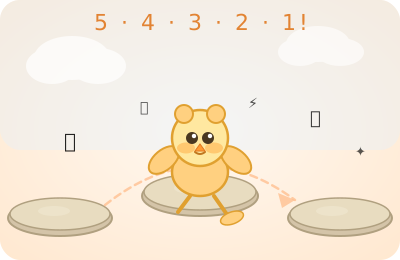
The 5-4-3-2-1 launcher. When you know what brave move to make and you’re frozen, count down out loud (or in your head) from 5. On “1,” your body goes. Don’t think — move. This trick interrupts the over-thinking loop just long enough for you to act.
Five small brave habits (pick two for this month)
You do not need to do all of these. Pick the two that scare you the most — that means they are the two with the most growth in them.
1. Speak first
At least once a day, be the person who speaks first. Say hi in the hallway. Ask the question in class. Greet the cashier. You are training yourself to be the starter, not the waiter.
2. Try one thing you’ll be bad at
Once a week, do something where you are guaranteed to be a beginner: a new sport, a new instrument, a new craft. Being a beginner trains you to survive being not-good — which is the actual root of confidence. Kids who have never been beginners are fragile when life inevitably makes them one.
3. Make eye contact during awkward moments
When you say thank you, when you apologize, when you ask for help — look the person in the eye for one full breath. This builds presence faster than any other trick.
4. Ask for what you want
Once a week, ask for something you would normally not ask for: extra help from a teacher, a different seat, a turn in a game, your real opinion to be heard. A small ask. The world will not end. Most asks get a yes.
5. Disagree out loud (kindly)
Once a week, share an opinion that is not the same as the person you’re talking to: “Hmm, I actually liked the ending”, “I see it differently”, “I don’t think that’s fair to her.” Confidence isn’t being right. Confidence is being okay being yourself in a room.
You do not become confident by avoiding scary things. You become confident by collecting evidence that you survive them. Each small brave act is a coin in your evidence jar.
The body trick most people don’t know
Your body and your mind are a two-way street. You already know that being nervous makes your body tense. The reverse is also true: changing your body changes your feelings.
Try this for two minutes before something hard:
- Stand up tall. Roll your shoulders back.
- Plant your feet shoulder-width apart.
- Take four slow breaths: 4 seconds in, 4 seconds hold, 6 seconds out.
- Say a sentence in your head that starts with “I am the kind of person who…”
This is not magic. It just lowers your heart rate and tells your brain “the threat is small.” Athletes and actors do this before going on. So can you.
What confidence is not
Confidence is not loud. The loudest kids in the room are often the most insecure — performing certainty so no one notices the shake. Quiet confidence is sitting calmly with your own opinion, even when no one agrees.
Confidence is not always being right. Confident people say “I don’t know” comfortably. Insecure people pretend.
Confidence is not never feeling small. Even the most confident people have moments of doubt. They just don’t believe the doubt.
When confidence dips
Some weeks you’ll feel like you’ve forgotten how to do everything you used to do well. Confidence isn’t a smooth line — it dips, especially after big changes (new school, new group, body changes, family stress).
When you dip:
- Shrink the goal. What is one tiny brave thing today? Not five. One.
- Look at evidence, not feelings. List three brave things you’ve done in the last month. They happened. Your dip is a feeling, not a fact.
- Move your body. A walk, a stretch, a dance. Your nervous system needs it more than your brain needs another thought.
- Talk to someone you trust. Not for advice — just to be heard.
Then pick one 20-second brave thing. Do it. Add a coin to the evidence jar. Begin again.
Tonight, write down one 20-second brave thing for tomorrow. Be specific: “I will say hi first to ___ in the hallway”, “I will ask the teacher about ___”, “I will join the lunch table I usually don’t sit at.” In the morning, do it before you can talk yourself out of it.